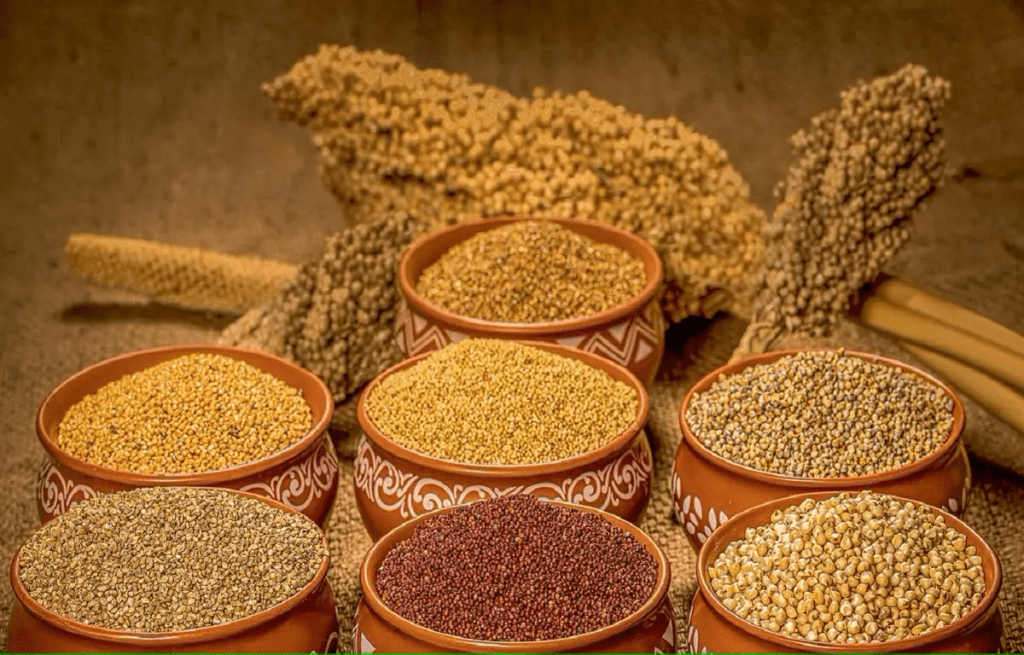
Millets are also used to prepare alcoholic beverages. Millets are traditionally important grains used in brewing millet beer in some cultures, for instance by the Tao people of Orchid Island and the Amis or Atayal of Taiwan. It is also the base ingredient for the buy millet online distilled liquor rakshi in Nepal and the indigenous alcoholic drink of the Sherpa, Tamang, Rai and Limbu people, tongba, in eastern Nepal.
Millets are major food sources in arid and semiarid regions of the world, and feature in the traditional cuisine of many others. Millet porridge is a traditional food in Russian, German, and Chinese cuisines.
In addition to being used for seed, millet is also used as a grazing forage crop. Instead of letting the plant reach maturity it can be grazed by stock and is commonly used for sheep and cattle.
Millets are safe when consumed in a moderate amount. It has been consumed as staple food by millions of peoples in the past thousands of years. However, excessive consumption of millet might cause an adverse effect. Millets contain goitrogen, a substance that interferes with the production of thyroid hormones and inhibits iodine uptake and utilization by the thyroid gland. Deficiency of iodine is a significant health problem which leads to the development of enlarged thyroid gland, known as goitre. Goitre causes dry skin, anxiety, depression and slow thinking. In the Sudan region of Africa where millet is consumed as the primary source of energy, the occurrence of goitre was much greater than anywhere else in the world. Hence, people with thyroid problems need to restrict their consumption of millets.
Cultivation of Millet
Millet is one of the oldest crops known to mankind. Both the ancestor and the location of domestication of millet are unknown. It was believed that millet was cultivated during the Neolithic period (8000-2000 B.C.) in China where farmers plant the proso millet during the Second Chinese Dynasty. Nowadays, millet still plays an important role in the diet of northwest China. Millets used to be cultivated in western Europe but with the extensive growth of potatoes, millet production increasing decreased and almost disappeared by the beginning of 20th century.
According to the Food and Agriculture Organization of the United Nations, millet production ranks fifth in the world cereal production, following corn, wheat, barley and sorghum. The production of millet had increased from 27.6 million tons in 2000 to 31.6 million tons in 2010. It is widely cultivated in the Russia, Ukraine, Kazakhstan, U.S., Argentina, Australia, Eastern Europe and southern India. The major exporters of proso millet are U.S., Argentina and Australia. The major millet importers are Belgium, Germany and Netherlands.
Millets have long been used as traditional staple foods by a large proportion of the world’s poor as in Asia and Africa. Currently, it was consumed in northern China, India, Africa and southern Russia. About 80% of the global millet production is directed consumed as human food in forms of porridges, breads, cakes, snacks, steamed goods and beverage. Because of lack of gluten, millet flour is normally used to make flat bread. Proso millet is used as a basic ingredient to make distilled alcoholic drink in Shanxi Province of China. It is also used to make bread-beer in Balkans, Egypt, Sudan and Turkey.
 Site Title
Leave a comment